
Analog Neuron Lab
Build neural networks you can touch.
Analog Neuron Lab is a real neural network in the physical world, where signals, weights, and activations are not code but voltages you can measure and adjust with real tools. Built for students, educators, and makers who want to connect equations to electronics.
What it is
A neural network you can build with your hands.
Not a simulation. Not software. Each neuron in Analog Neuron Lab is built from real analog electronics. Every input, weight, bias, and activation is a voltage, which means you can measure it with a multimeter or oscilloscope, watch weights and activations change in real time, and connect the math directly to a physical circuit. It turns abstract neural network ideas into phenomena you can touch and test.
Pure analog path
Everything stays continuous: inputs are voltages, math happens as currents, and outputs are instant analog levels. No ADC, no DAC, no firmware in the middle: turn a knob and the network moves with you.
Modular blocks
Each PCB is a role: inputs, neurons, layers, outputs, probes. Wire blocks in minutes to build real MLPs you can see on the desk: rewire, branch, and extend like hardware LEGO for neural nets.
Hands-on measurement
Probe any node with a multimeter or scope: inputs, sums, activations, outputs. See a weight tweak shift the boundary in real time: debugging becomes measuring, not guessing.
Product gallery
A physical neural network, built to be explored.
Real kit v1.0 photography.
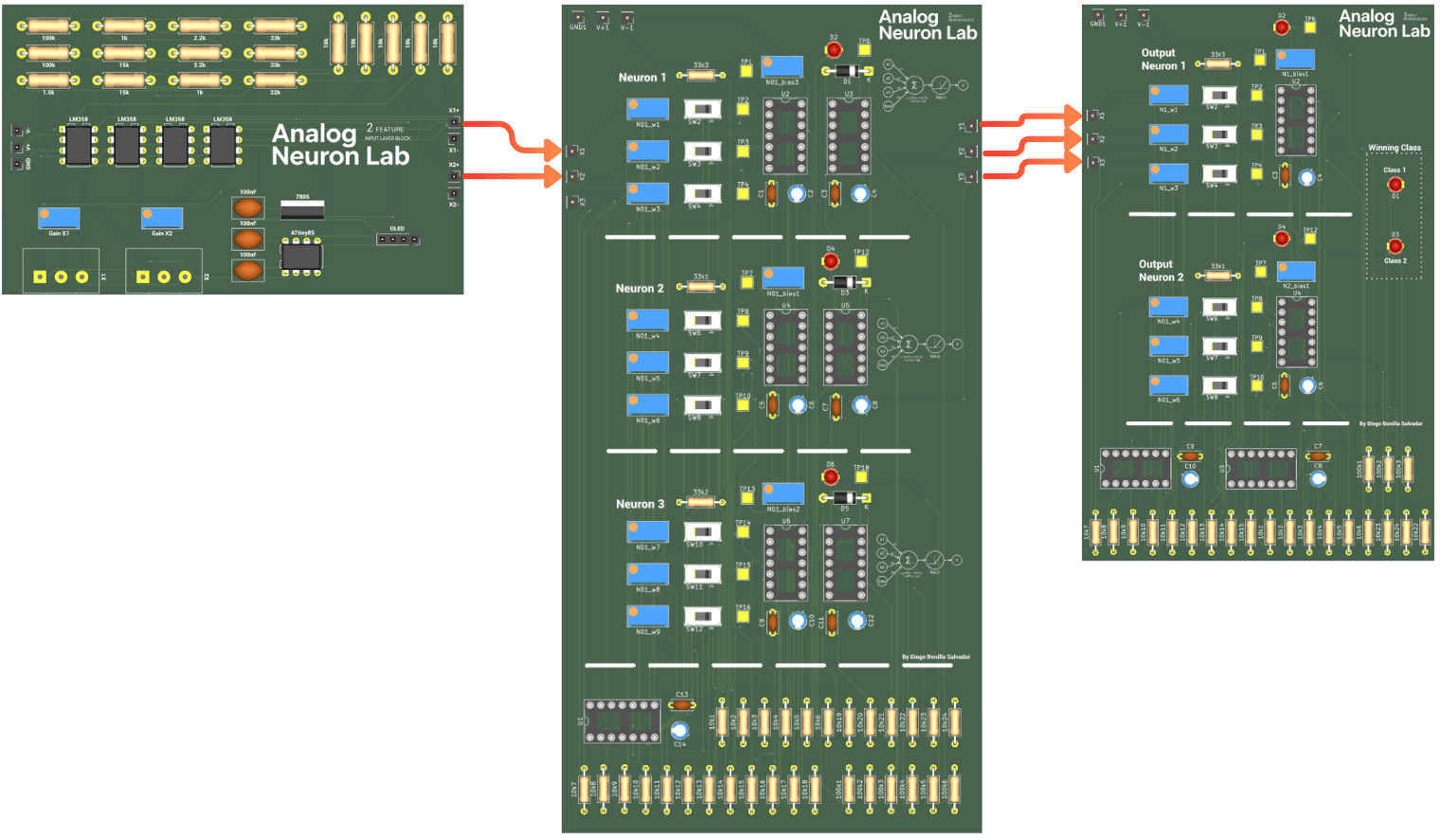
Module array
Core neuron blocks laid out for tuning. The input PCB connects to the hidden layer and then to the output PCB.
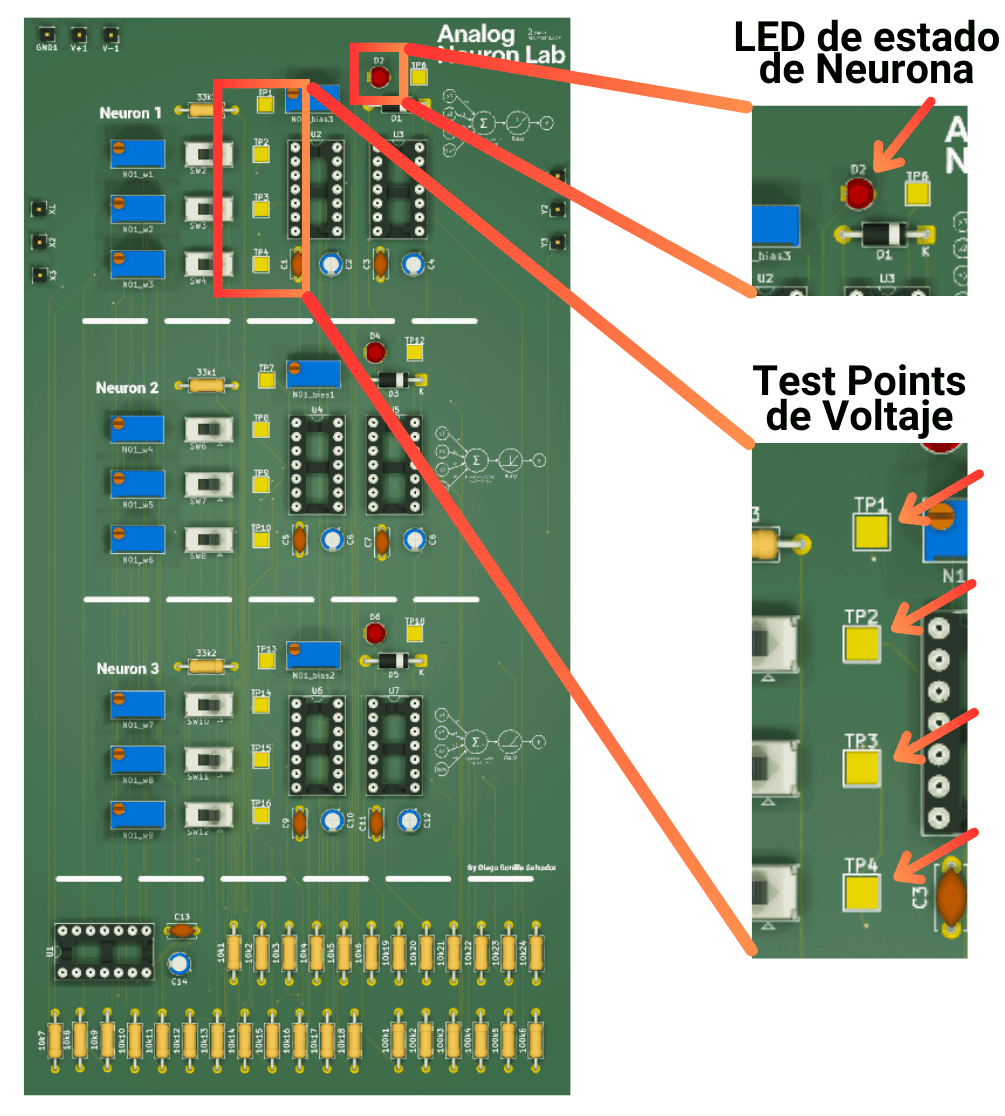
Test points and LEDs
Patch the network like a synth using any simple DC multimeter or oscilloscope.
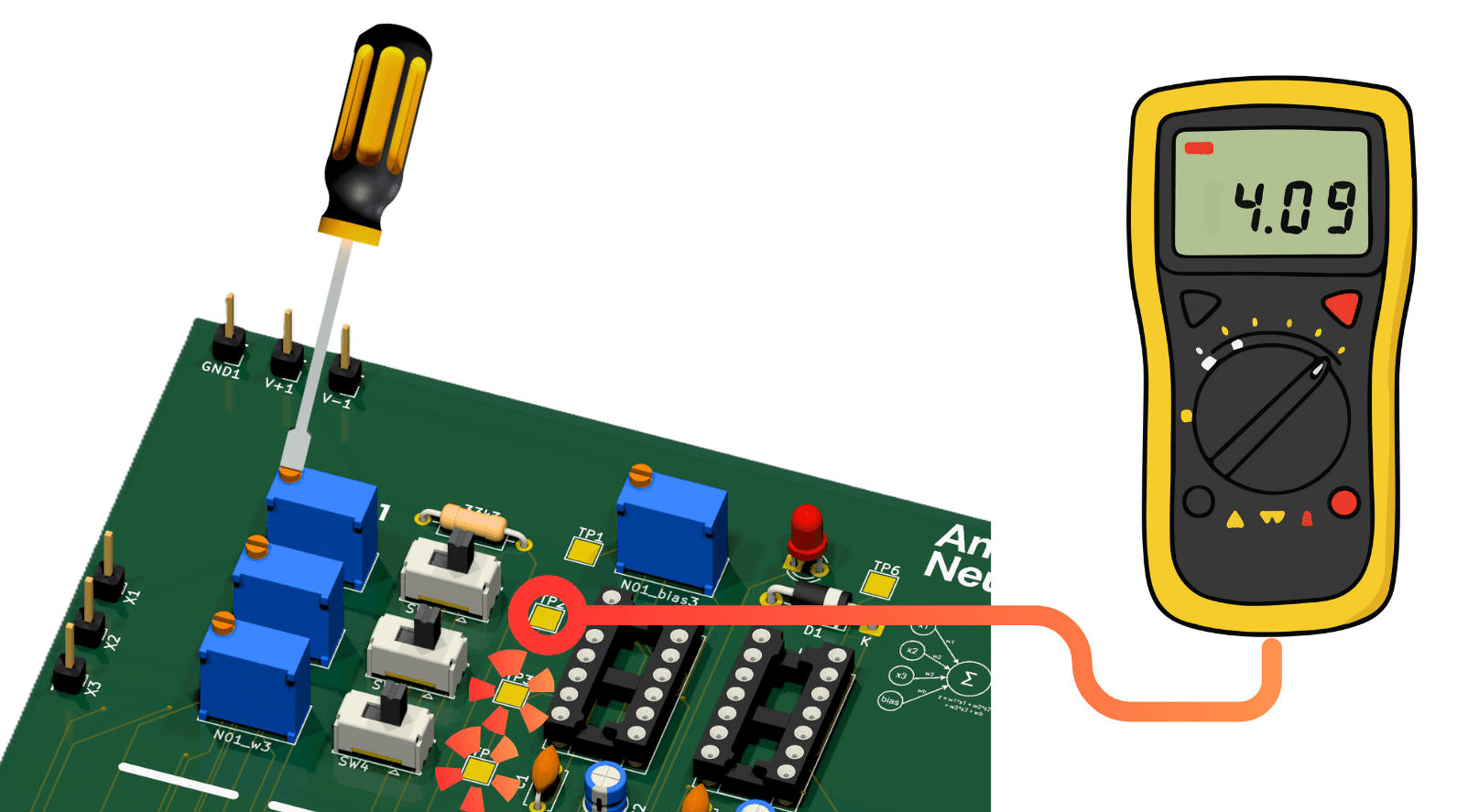
Weight tuning
Dial in weights with trimmer potentiometers and adjust them.
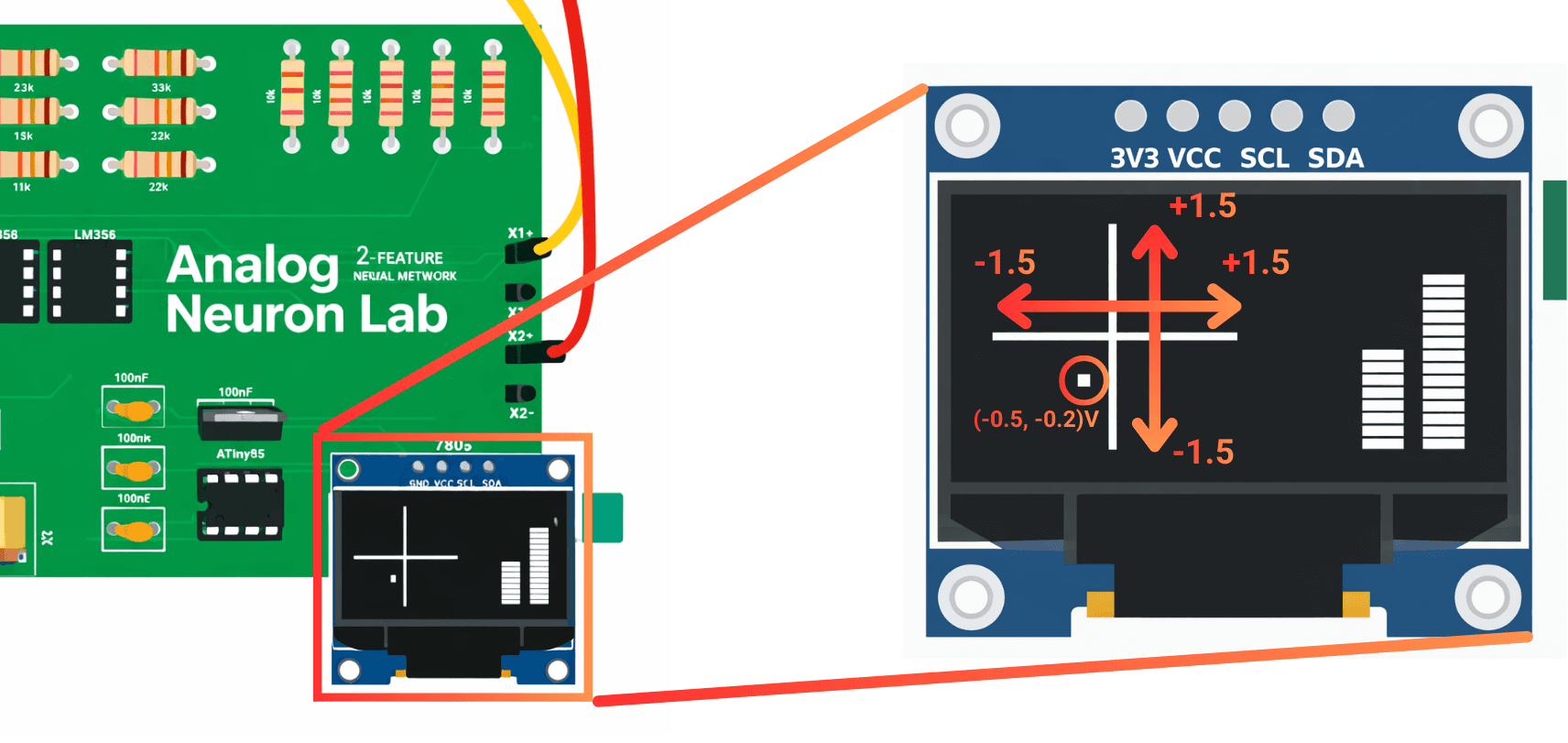
Built-in oscilloscope
See the inputs as 2D points in the included OLED screen.
Training app
Train, visualize, and set voltages without code
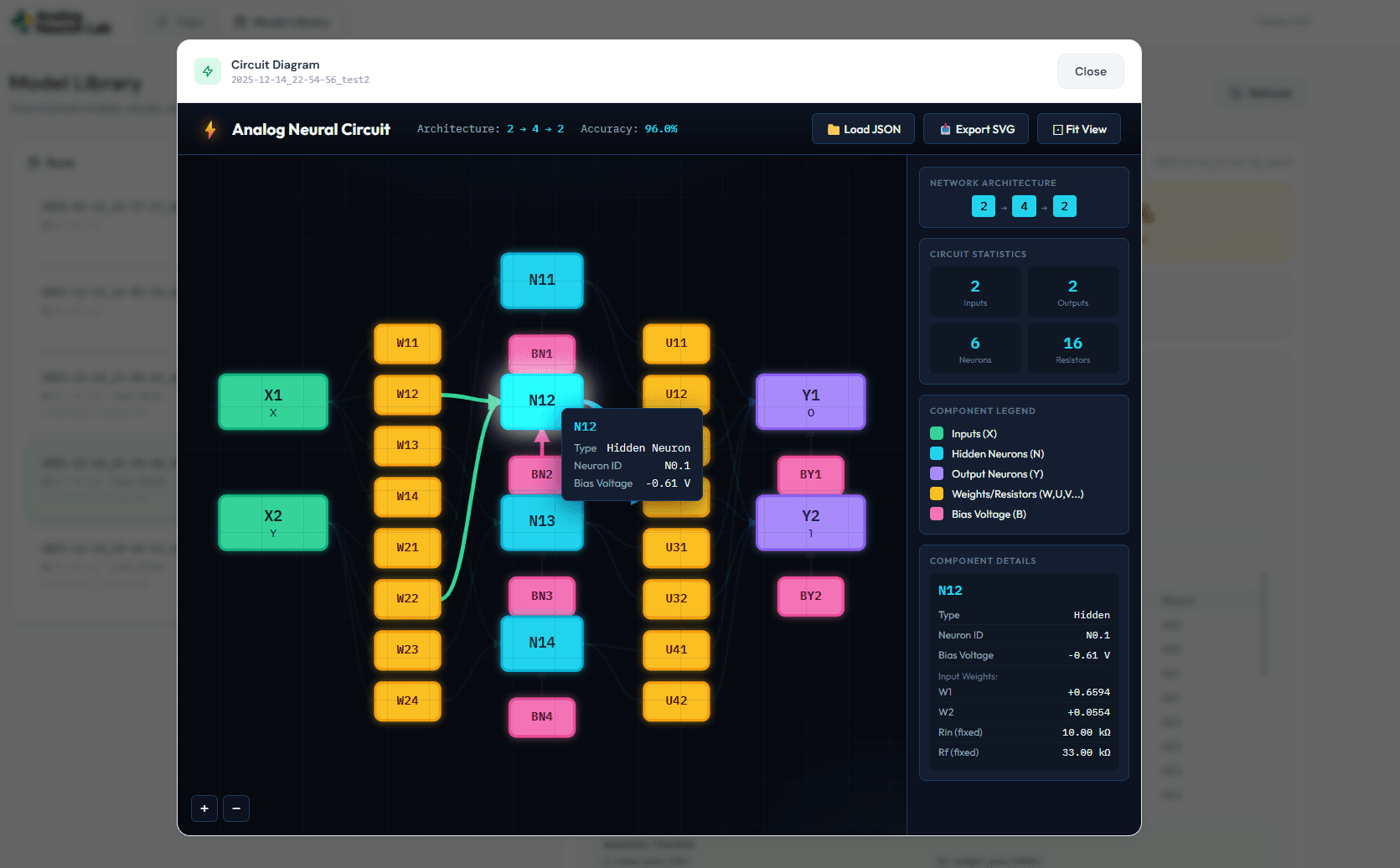
The desktop trainer lets you load a dataset, run a quick fit, and export exact volt targets for every node. A built-in visualizer draws the trained model as an easy diagram so you can dial the trimmers to the right voltages without writing code or doing math.
Download trainer (Windows)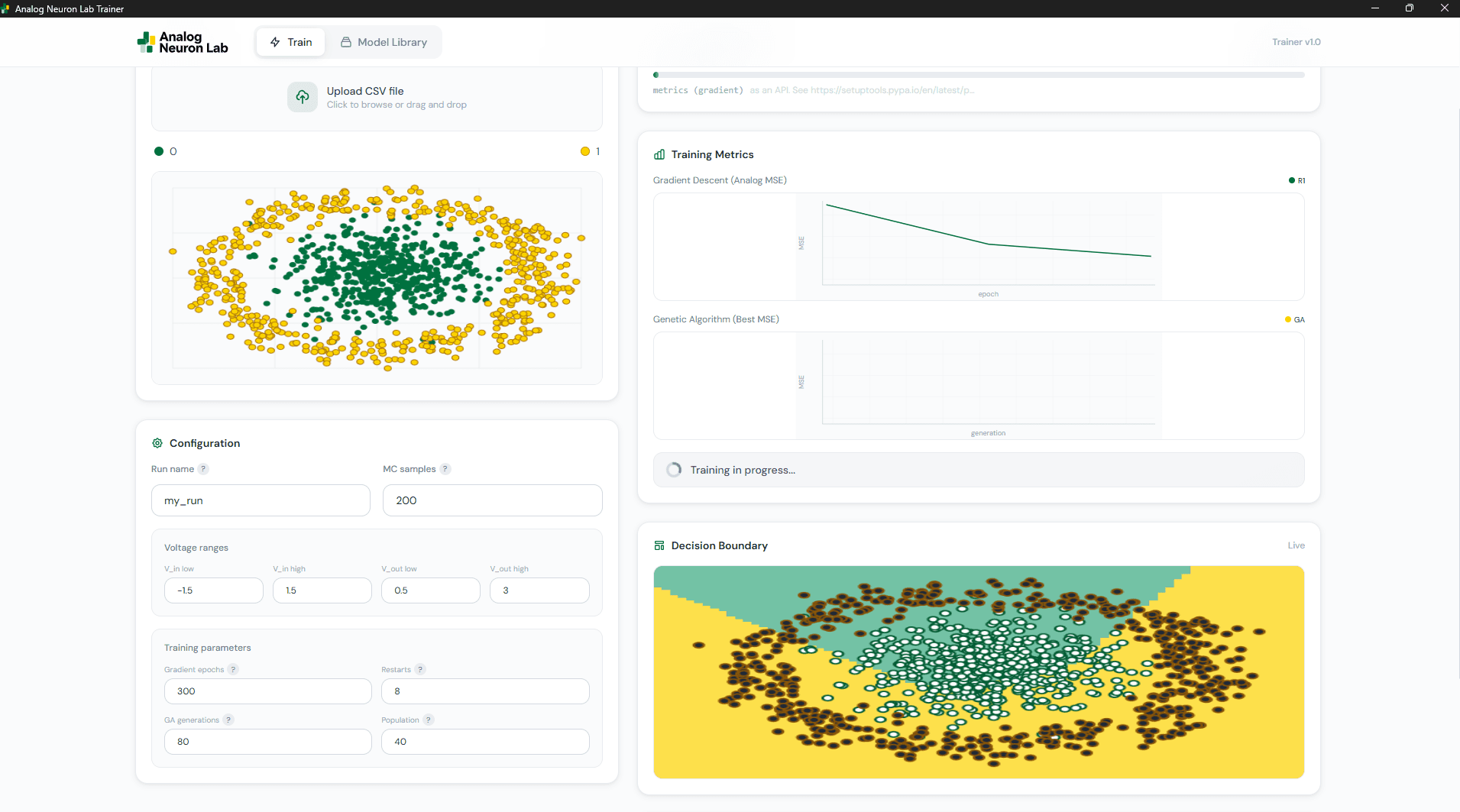
How it works
Four physical concepts that make the network real.
Inputs become voltages
Inputs are real voltages that represent data you can inject, measure, and trace through the circuit.
Probe inputs with a multimeter or oscilloscope.
Weights are physical controls
Weights are adjustable with trimmers or the app, so you can see how each change reshapes the response.
Turn a knob and watch the boundary move.
Bias sets the reference
Bias is a reference voltage that shifts the decision point and shows how offsets change behavior.
Shift the response with a single bias voltage.
Activation is analog
The activation function is built with real analog components, so you can see nonlinearity emerge in hardware.
Watch the nonlinearity happen on the bench.
Learning path
For almost all ages, from zero code to serious projects
What you will master at each stage: Beginner: identify analog signals, measure voltages with a multimeter, and understand a weighted sum as a physical sum of voltages. Practitioner: connect activation functions to diode and amplifier behavior, and adjust weights to change the network response. Master: analyze tolerances and noise, compare physical versus mathematical performance, and map the error limits of real hardware.
Who it is for
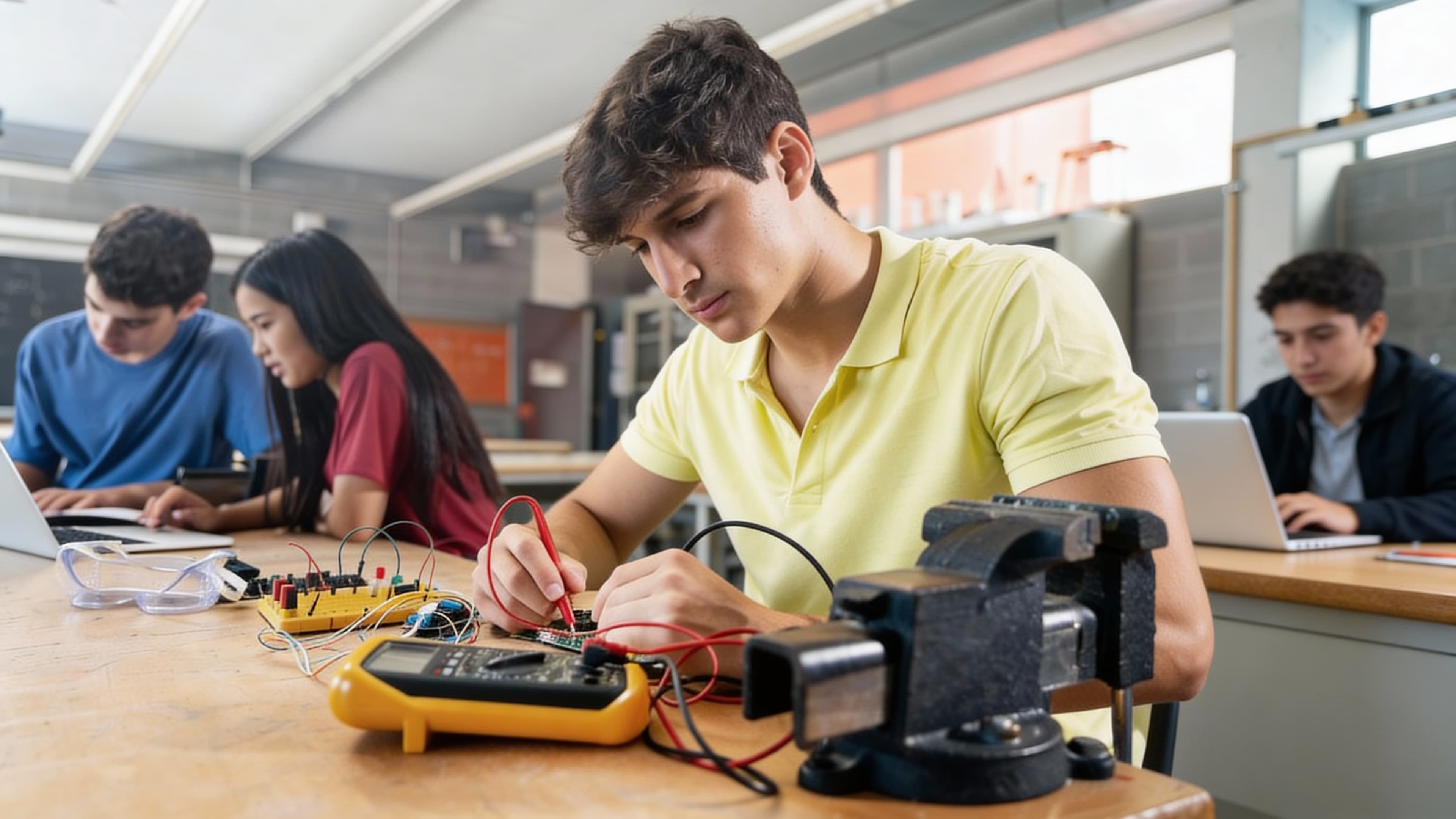
For students, educators, and makers who want real outcomes.
High school
Learn how a neuron behaves physically without relying on software or simulations.
Vocational training
Connect electronics and artificial intelligence through practical, real world experimentation.
University
Bridge mathematical theory with real electronics and measurable signals.
Hobbyists
Experiment, measure, and build your own neural projects with a hands on kit.
Guide PDF
Analog Neuron Lab guide
Work in progress, updated regularly.
The kit comes with a structured lab guide designed to be read like a real textbook and used like a real lab notebook. It is currently written in Spanish, with a clear progression through three depths of understanding: an intuitive path for beginners, a technical path that connects circuits to the standard neural network notation, and an advanced path that treats the system as a physical model with limits, calibration, and uncertainty. An English translation is in progress, and the goal is to keep the same style, visuals, and rigor across both languages.

About the author
Hi, I am Diego.
I am a huge electronic enthusiast and deep learning researcher interested in the intersection of modern AI and physical systems. I work professionally in computer vision and generative models, and I also teach and give lectures on artificial intelligence at various universities and courses. Analog Neuron Lab comes from a long term personal motivation: removing the abstraction barrier that makes neural networks feel opaque, and turning them back into something tangible, measurable, and understandable. This project is my way of merging rigorous AI research with hands on electronics to make learning honest, physical, and intuitive.
Waitlist
Start teaching neural networks in a way students never forget.
Request your kit now and get access to the educational materials as soon as they are released.